Discuss What You Know About Friction
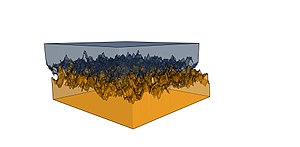
Figure one: Simulated blocks with fractal crude surfaces, exhibiting static frictional interactions[i]
Friction is the forcefulness resisting the relative motion of solid surfaces, fluid layers, and material elements sliding against each other.[two] There are several types of friction:
- Dry friction is a force that opposes the relative lateral move of two solid surfaces in contact. Dry out friction is subdivided into static friction ("stiction") between non-moving surfaces, and kinetic friction between moving surfaces. With the exception of atomic or molecular friction, dry friction generally arises from the interaction of surface features, known equally asperities (meet Figure one).
- Fluid friction describes the friction between layers of a viscous fluid that are moving relative to each other.[iii] [4]
- Lubricated friction is a case of fluid friction where a lubricant fluid separates two solid surfaces.[5] [6] [vii]
- Pare friction is a component of drag, the force resisting the motility of a fluid across the surface of a body.
- Internal friction is the force resisting motion between the elements making up a solid material while it undergoes deformation.[4]
When surfaces in contact movement relative to each other, the friction between the two surfaces converts kinetic energy into thermal energy (that is, it converts work to estrus). This holding can have dramatic consequences, as illustrated past the use of friction created past rubbing pieces of wood together to beginning a burn. Kinetic free energy is converted to thermal free energy whenever motion with friction occurs, for case when a viscous fluid is stirred. Another important event of many types of friction can be clothing, which may lead to functioning deposition or damage to components. Friction is a component of the science of tribology.
Friction is desirable and important in supplying traction to facilitate motion on land. Most land vehicles rely on friction for acceleration, deceleration and changing direction. Sudden reductions in traction can cause loss of command and accidents.
Friction is not itself a fundamental force. Dry friction arises from a combination of inter-surface adhesion, surface roughness, surface deformation, and surface contamination. The complexity of these interactions makes the calculation of friction from outset principles impractical and necessitates the use of empirical methods for analysis and the development of theory.
Friction is a non-conservative force – work washed against friction is path dependent. In the presence of friction, some kinetic energy is e'er transformed to thermal energy, so mechanical free energy is not conserved.
History
The Greeks, including Aristotle, Vitruvius, and Pliny the Elder, were interested in the crusade and mitigation of friction.[8] They were enlightened of differences between static and kinetic friction with Themistius stating in 350 A.D. that "it is easier to further the motion of a moving body than to move a body at rest".[8] [9] [10] [11]
The archetype laws of sliding friction were discovered by Leonardo da Vinci in 1493, a pioneer in tribology, but the laws documented in his notebooks were not published and remained unknown.[12] [13] [fourteen] [15] [16] [17] These laws were rediscovered by Guillaume Amontons in 1699[eighteen] and became known every bit Amonton's three laws of dry out friction. Amontons presented the nature of friction in terms of surface irregularities and the force required to heighten the weight pressing the surfaces together. This view was farther elaborated by Bernard Wood de Bélidor[19] and Leonhard Euler (1750), who derived the angle of repose of a weight on an inclined plane and showtime distinguished betwixt static and kinetic friction.[xx] John Theophilus Desaguliers (1734) first recognized the office of adhesion in friction.[21] Microscopic forces crusade surfaces to stick together; he proposed that friction was the force necessary to tear the adhering surfaces apart.
The understanding of friction was farther developed past Charles-Augustin de Coulomb (1785).[18] Coulomb investigated the influence of iv main factors on friction: the nature of the materials in contact and their surface coatings; the extent of the surface expanse; the normal pressure (or load); and the length of time that the surfaces remained in contact (fourth dimension of repose).[12] Coulomb further considered the influence of sliding velocity, temperature and humidity, in order to decide between the different explanations on the nature of friction that had been proposed. The distinction between static and dynamic friction is made in Coulomb's friction constabulary (see below), although this stardom was already drawn by Johann Andreas von Segner in 1758.[12] The upshot of the time of repose was explained past Pieter van Musschenbroek (1762) by considering the surfaces of fibrous materials, with fibers meshing together, which takes a finite fourth dimension in which the friction increases.
John Leslie (1766–1832) noted a weakness in the views of Amontons and Coulomb: If friction arises from a weight being drawn upwardly the inclined aeroplane of successive asperities, why then isn't it balanced through descending the opposite slope? Leslie was equally skeptical nearly the role of adhesion proposed past Desaguliers, which should on the whole take the same tendency to accelerate equally to retard the motion.[12] In Leslie'due south view, friction should be seen equally a fourth dimension-dependent process of flattening, pressing down asperities, which creates new obstacles in what were cavities earlier.
Arthur Jules Morin (1833) adult the concept of sliding versus rolling friction. Osborne Reynolds (1866) derived the equation of viscous menses. This completed the classic empirical model of friction (static, kinetic, and fluid) unremarkably used today in engineering science.[thirteen] In 1877, Fleeming Jenkin and J. A. Ewing investigated the continuity between static and kinetic friction.[22]
The focus of research during the 20th century has been to understand the physical mechanisms behind friction. Frank Philip Bowden and David Tabor (1950) showed that, at a microscopic level, the actual area of contact between surfaces is a very modest fraction of the apparent area.[fourteen] This actual area of contact, acquired by asperities increases with pressure. The evolution of the atomic force microscope (ca. 1986) enabled scientists to study friction at the atomic scale,[13] showing that, on that scale, dry out friction is the product of the inter-surface shear stress and the contact area. These ii discoveries explain Amonton's get-go law (beneath); the macroscopic proportionality between normal forcefulness and static frictional strength between dry surfaces.
Laws of dry friction
The elementary property of sliding (kinetic) friction were discovered past experiment in the 15th to 18th centuries and were expressed as iii empirical laws:
- Amontons' First Law: The force of friction is straight proportional to the applied load.
- Amontons' Second Police force: The force of friction is independent of the apparent surface area of contact.
- Coulomb'south Police force of Friction: Kinetic friction is independent of the sliding velocity.
Dry friction
Dry friction resists relative lateral motion of two solid surfaces in contact. The two regimes of dry out friction are 'static friction' ("stiction") between non-moving surfaces, and kinetic friction (sometimes chosen sliding friction or dynamic friction) between moving surfaces.
Coulomb friction, named later on Charles-Augustin de Coulomb, is an approximate model used to summate the strength of dry friction. It is governed by the model:

where
The Coulomb friction may take whatsoever value from nada upwardly to , and the direction of the frictional strength confronting a surface is contrary to the move that surface would experience in the absence of friction. Thus, in the static instance, the frictional force is exactly what it must be in order to prevent movement between the surfaces; it balances the net force tending to cause such motion. In this case, rather than providing an approximate of the actual frictional strength, the Coulomb approximation provides a threshold value for this force, higher up which motion would commence. This maximum force is known equally traction.


The forcefulness of friction is always exerted in a direction that opposes movement (for kinetic friction) or potential movement (for static friction) betwixt the ii surfaces. For example, a curling stone sliding along the ice experiences a kinetic force slowing information technology down. For an example of potential motility, the drive wheels of an accelerating machine feel a frictional force pointing forward; if they did not, the wheels would spin, and the rubber would slide backwards forth the pavement. Note that it is not the management of movement of the vehicle they oppose, it is the direction of (potential) sliding betwixt tire and route.
Normal forcefulness
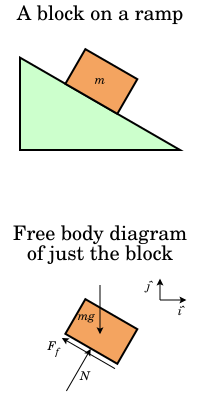
Free-body diagram for a block on a ramp. Arrows are vectors indicating directions and magnitudes of forces. North is the normal strength, mg is the force of gravity, and Ff is the force of friction.
The normal strength is defined every bit the internet strength compressing two parallel surfaces together, and its direction is perpendicular to the surfaces. In the simple case of a mass resting on a horizontal surface, the only component of the normal force is the strength due to gravity, where . In this case, conditions of equilibrium tell us that the magnitude of the friction force is zero, . In fact, the friction force always satisfies , with equality reached only at a critical ramp angle (given past ) that is steep enough to initiate sliding.


The friction coefficient is an empirical (experimentally measured) structural belongings that depends simply on various aspects of the contacting materials, such as surface roughness. The coefficient of friction is not a function of mass or volume. For case, a large aluminum block has the same coefficient of friction equally a small aluminum block. However, the magnitude of the friction force itself depends on the normal force, and hence on the mass of the cake.
Depending on the situation, the calculation of the normal force might include forces other than gravity. If an object is on a level surface and subjected to an external force tending to crusade it to slide, then the normal strength betwixt the object and the surface is just , where is the block's weight and is the downward component of the external forcefulness. Prior to sliding, this friction force is , where is the horizontal component of the external force. Thus, in general. Sliding commences only after this frictional force reaches the value . Until and so, friction is whatsoever it needs to be to provide equilibrium, so it tin be treated as merely a reaction.


If the object is on a tilted surface such equally an inclined plane, the normal force from gravity is smaller than , because less of the strength of gravity is perpendicular to the face of the airplane. The normal force and the frictional forcefulness are ultimately adamant using vector assay, ordinarily via a free torso diagram.
In general, process for solving any statics problem with friction is to care for contacting surfaces tentatively as immovable so that the corresponding tangential reaction strength between them can be calculated. If this frictional reaction force satisfies , then the tentative supposition was right, and it is the actual frictional force. Otherwise, the friction force must be set equal to , and then the resulting force imbalance would then determine the acceleration associated with slipping.
Coefficient of friction
![[icon]](https://upload.wikimedia.org/wikipedia/commons/thumb/1/1c/Wiki_letter_w_cropped.svg/20px-Wiki_letter_w_cropped.svg.png) | This section needs expansion with: explanation of why kinetic friction is always lower. You tin can assist past adding to it. (August 2020) |
The coefficient of friction (COF), oft symbolized past the Greek letter µ, is a dimensionless scalar value which equals the ratio of the force of friction between two bodies and the force pressing them together, either during or at the onset of slipping. The coefficient of friction depends on the materials used; for example, water ice on steel has a low coefficient of friction, while rubber on pavement has a high coefficient of friction. Coefficients of friction range from well-nigh zero to greater than one. The coefficient of friction between ii surfaces of similar metals is greater than that betwixt 2 surfaces of different metals; for example, brass has a higher coefficient of friction when moved against brass, but less if moved against steel or aluminum.[23]
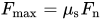
For surfaces at residuum relative to each other , where is the coefficient of static friction. This is unremarkably larger than its kinetic counterpart. The coefficient of static friction exhibited by a pair of contacting surfaces depends upon the combined effects of material deformation characteristics and surface roughness, both of which accept their origins in the chemical bonding between atoms in each of the bulk materials and between the material surfaces and whatever adsorbed material. The fractality of surfaces, a parameter describing the scaling behavior of surface asperities, is known to play an important part in determining the magnitude of the static friction.[1]


For surfaces in relative motion , where is the coefficient of kinetic friction. The Coulomb friction is equal to , and the frictional force on each surface is exerted in the management opposite to its motion relative to the other surface.


Arthur Morin introduced the term and demonstrated the utility of the coefficient of friction.[12] The coefficient of friction is an empirical measurement – it has to be measured experimentally, and cannot exist found through calculations.[24] Rougher surfaces tend to have higher effective values. Both static and kinetic coefficients of friction depend on the pair of surfaces in contact; for a given pair of surfaces, the coefficient of static friction is usually larger than that of kinetic friction; in some sets the two coefficients are equal, such equally teflon-on-teflon.
Near dry materials in combination have friction coefficient values between 0.iii and 0.half dozen. Values outside this range are rarer, but teflon, for instance, can have a coefficient as low equally 0.04. A value of cipher would mean no friction at all, an elusive property. Safe in contact with other surfaces tin yield friction coefficients from i to 2. Occasionally it is maintained that μ is always < 1, merely this is not true. While in most relevant applications μ < 1, a value above 1 merely implies that the strength required to slide an object along the surface is greater than the normal force of the surface on the object. For case, silicone safe or acrylic rubber-coated surfaces take a coefficient of friction that can be essentially larger than 1.
While it is frequently stated that the COF is a "material property," it is better categorized every bit a "system property." Dissimilar true material properties (such as conductivity, dielectric abiding, yield strength), the COF for whatever ii materials depends on organisation variables like temperature, velocity, atmosphere and also what are at present popularly described every bit aging and deaging times; as well as on geometric properties of the interface between the materials, namely surface construction.[1] For example, a copper pivot sliding against a thick copper plate tin take a COF that varies from 0.6 at depression speeds (metallic sliding against metal) to below 0.2 at high speeds when the copper surface begins to cook due to frictional heating. The latter speed, of course, does not determine the COF uniquely; if the pin diameter is increased so that the frictional heating is removed rapidly, the temperature drops, the pin remains solid and the COF rises to that of a 'depression speed' test.[ citation needed ]
Guess coefficients of friction
| Materials | Static Friction, | Kinetic/Sliding Friction, | |||
|---|---|---|---|---|---|
| Dry and clean | Lubricated | Dry and clean | Lubricated | ||
| Aluminium | Steel | 0.61[25] | 0.47[25] | ||
| Aluminium | Aluminium | 1.05–1.35[25] | 0.3[25] | one.iv[25]–1.5[26] | |
| Gold | Gold | ii.five[26] | |||
| Platinum | Platinum | 1.2[25] | 0.25[25] | 3.0[26] | |
| Silver | Silver | 1.4[25] | 0.55[25] | i.five[26] | |
| Alumina ceramic | Silicon nitride ceramic | 0.004 (wet)[27] | |||
| BAM (Ceramic alloy AlMgB14) | Titanium boride (TiBii) | 0.04–0.05[28] | 0.02[29] [30] | ||
| Brass | Steel | 0.35–0.51[25] | 0.19[25] | 0.44[25] | |
| Bandage atomic number 26 | Copper | ane.05[25] | 0.29[25] | ||
| Cast iron | Zinc | 0.85[25] | 0.21[25] | ||
| Physical | Rubber | 1.0 | 0.30 (wet) | 0.half-dozen–0.85[25] | 0.45–0.75 (wet)[25] |
| Concrete | Forest | 0.62[25] [31] | |||
| Copper | Glass | 0.68[32] | 0.53[32] | ||
| Copper | Steel | 0.53[32] | 0.36[25] [32] | 0.18[32] | |
| Glass | Glass | 0.9–ane.0[25] [32] | 0.005–0.01[32] | 0.4[25] [32] | 0.09–0.116[32] |
| Human synovial fluid | Man cartilage | 0.01[33] | 0.003[33] | ||
| Ice | Ice | 0.02–0.09[34] | |||
| Polyethene | Steel | 0.two[25] [34] | 0.two[25] [34] | ||
| PTFE (Teflon) | PTFE (Teflon) | 0.04[25] [34] | 0.04[25] [34] | 0.04[25] | |
| Steel | Ice | 0.03[34] | |||
| Steel | PTFE (Teflon) | 0.04[25]−0.two[34] | 0.04[25] | 0.04[25] | |
| Steel | Steel | 0.74[25]−0.80[34] | 0.005–0.23[32] [34] | 0.42–0.62[25] [32] | 0.029–0.19[32] |
| Forest | Metal | 0.2–0.six[25] [31] | 0.2 (wet)[25] [31] | 0.49[32] | 0.075[32] |
| Wood | Wood | 0.25–0.62[25] [31] [32] | 0.two (wet)[25] [31] | 0.32–0.48[32] | 0.067–0.167[32] |
Under certain conditions some materials have very low friction coefficients. An example is (highly ordered pyrolytic) graphite which tin have a friction coefficient below 0.01.[35] This ultralow-friction regime is chosen superlubricity.
Static friction

When the mass is non moving, the object experiences static friction. The friction increases every bit the practical force increases until the block moves. Afterward the cake moves, information technology experiences kinetic friction, which is less than the maximum static friction.
Static friction is friction betwixt two or more solid objects that are not moving relative to each other. For instance, static friction can prevent an object from sliding down a sloped surface. The coefficient of static friction, typically denoted as μ s, is usually higher than the coefficient of kinetic friction. Static friction is considered to ascend every bit the event of surface roughness features across multiple length scales at solid surfaces. These features, known every bit asperities are present downwards to nano-scale dimensions and result in true solid to solid contact existing only at a limited number of points bookkeeping for only a fraction of the credible or nominal contact expanse.[36] The linearity between applied load and truthful contact area, arising from asperity deformation, gives rise to the linearity betwixt static frictional force and normal force, found for typical Amonton–Coulomb type friction.[37]
The static friction force must be overcome past an applied force before an object tin move. The maximum possible friction force betwixt two surfaces before sliding begins is the production of the coefficient of static friction and the normal forcefulness: . When there is no sliding occurring, the friction forcefulness can have any value from zero up to . Whatsoever forcefulness smaller than attempting to slide 1 surface over the other is opposed by a frictional force of equal magnitude and opposite management. Any strength larger than overcomes the force of static friction and causes sliding to occur. The instant sliding occurs, static friction is no longer applicable—the friction between the two surfaces is and so called kinetic friction. However, an credible static friction tin be observed even in the case when the true static friction is zero.[38]

An example of static friction is the force that prevents a car wheel from slipping as it rolls on the basis. Even though the bicycle is in movement, the patch of the tire in contact with the basis is stationary relative to the basis, so it is static rather than kinetic friction. Upon slipping, the wheel friction changes to kinetic friction. An anti-lock braking system operates on the principle of allowing a locked wheel to resume rotating then that the car maintains static friction.
The maximum value of static friction, when move is impending, is sometimes referred to as limiting friction,[39] although this term is non used universally.[three]
Kinetic friction
Kinetic friction, too known as dynamic friction or sliding friction, occurs when two objects are moving relative to each other and rub together (like a sled on the footing). The coefficient of kinetic friction is typically denoted as μ k, and is usually less than the coefficient of static friction for the aforementioned materials.[40] [41] Nevertheless, Richard Feynman comments that "with dry metals it is very hard to evidence whatever divergence."[42] The friction strength between two surfaces after sliding begins is the product of the coefficient of kinetic friction and the normal forcefulness: . This is responsible for the Coulomb damping of an oscillating or vibrating system.

New models are beginning to show how kinetic friction can be greater than static friction. Kinetic friction is now understood, in many cases, to be primarily caused by chemic bonding betwixt the surfaces, rather than interlocking asperities;[44] withal, in many other cases roughness effects are ascendant, for example in safe to road friction. Surface roughness and contact area touch on kinetic friction for micro- and nano-scale objects where surface area forces dominate inertial forces.[45]
The origin of kinetic friction at nanoscale can exist explained by thermodynamics.[46] Upon sliding, new surface forms at the back of a sliding truthful contact, and existing surface disappears at the forepart of it. Since all surfaces involve the thermodynamic surface free energy, piece of work must be spent in creating the new surface, and free energy is released as heat in removing the surface. Thus, a forcefulness is required to move the back of the contact, and frictional heat is released at the front end.

Angle of friction, θ, when cake just starts to slide.
Angle of friction
For sure applications, it is more than useful to define static friction in terms of the maximum angle earlier which one of the items volition begin sliding. This is called the angle of friction or friction angle. It is defined as:

where is the angle from horizontal and μs is the static coefficient of friction between the objects.[47] This formula tin as well exist used to calculate μs from empirical measurements of the friction angle.

Friction at the atomic level
Determining the forces required to motility atoms past each other is a challenge in designing nanomachines. In 2008 scientists for the first time were able to move a unmarried atom across a surface, and measure the forces required. Using ultrahigh vacuum and about zero temperature (5 M), a modified diminutive strength microscope was used to elevate a cobalt atom, and a carbon monoxide molecule, across surfaces of copper and platinum.[48]
Limitations of the Coulomb model
The Coulomb approximation follows from the assumptions that: surfaces are in atomically close contact only over a small fraction of their overall expanse; that this contact surface area is proportional to the normal force (until saturation, which takes place when all area is in atomic contact); and that the frictional force is proportional to the applied normal strength, independently of the contact surface area. The Coulomb approximation is fundamentally an empirical construct. Information technology is a rule-of-thumb describing the approximate outcome of an extremely complicated physical interaction. The strength of the approximation is its simplicity and versatility. Though the human relationship betwixt normal force and frictional forcefulness is non exactly linear (and so the frictional force is non entirely independent of the contact area of the surfaces), the Coulomb approximation is an acceptable representation of friction for the analysis of many physical systems.
When the surfaces are conjoined, Coulomb friction becomes a very poor approximation (for example, adhesive record resists sliding fifty-fifty when there is no normal force, or a negative normal force). In this case, the frictional force may depend strongly on the area of contact. Some drag racing tires are adhesive for this reason. However, despite the complexity of the fundamental physics behind friction, the relationships are accurate enough to be useful in many applications.
"Negative" coefficient of friction
Equally of 2012[update], a single written report has demonstrated the potential for an finer negative coefficient of friction in the low-load government, significant that a subtract in normal force leads to an increase in friction. This contradicts everyday experience in which an increment in normal strength leads to an increase in friction.[49] This was reported in the periodical Nature in Oct 2012 and involved the friction encountered by an atomic force microscope stylus when dragged across a graphene sheet in the presence of graphene-adsorbed oxygen.[49]
Numerical simulation of the Coulomb model
Despite being a simplified model of friction, the Coulomb model is useful in many numerical simulation applications such as multibody systems and granular material. Even its nigh simple expression encapsulates the key effects of sticking and sliding which are required in many applied cases, although specific algorithms take to be designed in order to efficiently numerically integrate mechanical systems with Coulomb friction and bilateral or unilateral contact.[fifty] [51] [52] [53] [54] Some quite nonlinear effects, such equally the so-called Painlevé paradoxes, may exist encountered with Coulomb friction.[55]
Dry friction and instabilities
Dry friction tin induce several types of instabilities in mechanical systems which display a stable behaviour in the absence of friction.[56] These instabilities may be caused past the decrease of the friction force with an increasing velocity of sliding, by fabric expansion due to heat generation during friction (the thermo-elastic instabilities), or past pure dynamic furnishings of sliding of two elastic materials (the Adams–Martins instabilities). The latter were originally discovered in 1995 by George G. Adams and João Arménio Correia Martins for polish surfaces[57] [58] and were afterward found in periodic crude surfaces.[59] In item, friction-related dynamical instabilities are idea to be responsible for brake squeal and the 'vocal' of a drinking glass harp,[threescore] [61] phenomena which involve stick and skid, modelled every bit a drop of friction coefficient with velocity.[62]
A practically important example is the self-oscillation of the strings of bowed instruments such as the violin, cello, hurdy-gurdy, erhu, etc.
A connection between dry friction and flutter instability in a simple mechanical system has been discovered,[63] watch the movie for more details.
Frictional instabilities can lead to the formation of new self-organized patterns (or "secondary structures") at the sliding interface, such every bit in-situ formed tribofilms which are utilized for the reduction of friction and clothing in so-called self-lubricating materials.[64]
Fluid friction
Fluid friction occurs betwixt fluid layers that are moving relative to each other. This internal resistance to period is named viscosity. In everyday terms, the viscosity of a fluid is described as its "thickness". Thus, water is "thin", having a lower viscosity, while dear is "thick", having a higher viscosity. The less viscous the fluid, the greater its ease of deformation or motility.
All real fluids (except superfluids) offer some resistance to shearing and therefore are viscid. For education and explanatory purposes information technology is helpful to utilise the concept of an inviscid fluid or an ideal fluid which offers no resistance to shearing and and then is not gummy.
Lubricated friction
Lubricated friction is a case of fluid friction where a fluid separates two solid surfaces. Lubrication is a technique employed to reduce wear of i or both surfaces in close proximity moving relative to each another by interposing a substance called a lubricant between the surfaces.
In most cases the applied load is carried by pressure level generated within the fluid due to the frictional pasty resistance to movement of the lubricating fluid between the surfaces. Adequate lubrication allows smooth continuous functioning of equipment, with only balmy wear, and without excessive stresses or seizures at bearings. When lubrication breaks downwardly, metallic or other components tin rub destructively over each other, causing heat and possibly damage or failure.
Skin friction
Skin friction arises from the interaction between the fluid and the skin of the body, and is directly related to the area of the surface of the body that is in contact with the fluid. Skin friction follows the drag equation and rises with the square of the velocity.
Peel friction is caused past viscous drag in the boundary layer around the object. There are ii ways to decrease pare friction: the first is to shape the moving body then that smooth flow is possible, like an airfoil. The second method is to decrease the length and cross-section of the moving object every bit much as is practicable.
Internal friction
Internal friction is the force resisting move between the elements making up a solid fabric while it undergoes deformation.
Plastic deformation in solids is an irreversible modify in the internal molecular construction of an object. This modify may be due to either (or both) an practical force or a change in temperature. The change of an object's shape is called strain. The force causing it is called stress.
Rubberband deformation in solids is reversible change in the internal molecular construction of an object. Stress does not necessarily cause permanent change. As deformation occurs, internal forces oppose the applied strength. If the applied stress is not also big these opposing forces may completely resist the applied forcefulness, assuasive the object to presume a new equilibrium country and to return to its original shape when the forcefulness is removed. This is known as elastic deformation or elasticity.
Radiation friction
As a consequence of lite pressure, Einstein[65] in 1909 predicted the existence of "radiation friction" which would oppose the movement of matter. He wrote, "radiations volition exert pressure on both sides of the plate. The forces of pressure exerted on the two sides are equal if the plate is at remainder. Notwithstanding, if it is in motion, more radiation will be reflected on the surface that is ahead during the movement (front surface) than on the dorsum surface. The backward-interim force of force per unit area exerted on the front surface is thus larger than the force of pressure acting on the back. Hence, as the resultant of the ii forces, there remains a forcefulness that counteracts the movement of the plate and that increases with the velocity of the plate. Nosotros will call this resultant 'radiation friction' in cursory."
Other types of friction
Rolling resistance
Rolling resistance is the strength that resists the rolling of a wheel or other circular object forth a surface acquired past deformations in the object or surface. Generally the forcefulness of rolling resistance is less than that associated with kinetic friction.[66] Typical values for the coefficient of rolling resistance are 0.001.[67] One of the virtually mutual examples of rolling resistance is the movement of motor vehicle tires on a road, a process which generates heat and sound as past-products.[68]
Braking friction
Any bike equipped with a brake is capable of generating a large retarding force, unremarkably for the purpose of slowing and stopping a vehicle or slice of rotating mechanism. Braking friction differs from rolling friction because the coefficient of friction for rolling friction is pocket-sized whereas the coefficient of friction for braking friction is designed to exist large past choice of materials for brake pads.
Triboelectric effect
Rubbing dissimilar materials against 1 another can crusade a build-upward of electrostatic accuse, which can exist hazardous if flammable gases or vapours are nowadays. When the static build-up discharges, explosions can be caused past ignition of the flammable mixture.
Belt friction
Belt friction is a concrete property observed from the forces interim on a chugalug wrapped around a pulley, when one cease is beingness pulled. The resulting tension, which acts on both ends of the belt, tin be modeled past the belt friction equation.
In exercise, the theoretical tension acting on the belt or rope calculated past the chugalug friction equation can be compared to the maximum tension the chugalug tin can support. This helps a designer of such a rig to know how many times the belt or rope must be wrapped effectually the caster to prevent it from slipping. Mount climbers and sailing crews demonstrate a standard knowledge of chugalug friction when accomplishing bones tasks.
Reducing friction
Devices
Devices such as wheels, brawl bearings, roller bearings, and air absorber or other types of fluid bearings tin can change sliding friction into a much smaller type of rolling friction.
Many thermoplastic materials such as nylon, HDPE and PTFE are commonly used in low friction bearings. They are specially useful because the coefficient of friction falls with increasing imposed load.[69] For improved wear resistance, very loftier molecular weight grades are usually specified for heavy duty or critical bearings.
Lubricants
A common mode to reduce friction is by using a lubricant, such as oil, water, or grease, which is placed between the 2 surfaces, frequently dramatically lessening the coefficient of friction. The scientific discipline of friction and lubrication is called tribology. Lubricant technology is when lubricants are mixed with the application of science, especially to industrial or commercial objectives.
Superlubricity, a recently discovered effect, has been observed in graphite: it is the substantial decrease of friction between two sliding objects, budgeted zero levels. A very small amount of frictional free energy would even so be dissipated.
Lubricants to overcome friction need non always be thin, turbulent fluids or powdery solids such every bit graphite and talc; audio-visual lubrication actually uses sound as a lubricant.
Some other way to reduce friction betwixt two parts is to superimpose micro-scale vibration to i of the parts. This can exist sinusoidal vibration equally used in ultrasound-assisted cutting or vibration dissonance, known as dither.
Energy of friction
According to the police of conservation of energy, no free energy is destroyed due to friction, though it may be lost to the system of concern. Energy is transformed from other forms into thermal free energy. A sliding hockey puck comes to residual because friction converts its kinetic energy into heat which raises the thermal energy of the puck and the water ice surface. Since heat quickly dissipates, many early philosophers, including Aristotle, wrongly concluded that moving objects lose energy without a driving forcefulness.
When an object is pushed along a surface along a path C, the energy converted to heat is given by a line integral, in accordance with the definition of work

where
- is the friction forcefulness,
- is the vector obtained by multiplying the magnitude of the normal strength by a unit vector pointing against the object'southward motion,
- is the coefficient of kinetic friction, which is inside the integral because information technology may vary from location to location (e.k. if the textile changes along the path),
- is the position of the object.


Energy lost to a system equally a event of friction is a classic example of thermodynamic irreversibility.
Work of friction
In the reference frame of the interface betwixt ii surfaces, static friction does no work, because there is never displacement betwixt the surfaces. In the aforementioned reference frame, kinetic friction is always in the direction opposite the motion, and does negative piece of work.[70] However, friction can exercise positive work in certain frames of reference. 1 can see this by placing a heavy box on a rug, then pulling on the rug quickly. In this case, the box slides backwards relative to the rug, simply moves forward relative to the frame of reference in which the flooring is stationary. Thus, the kinetic friction between the box and rug accelerates the box in the same direction that the box moves, doing positive work.[71]
The work washed by friction can translate into deformation, wear, and heat that can affect the contact surface properties (even the coefficient of friction between the surfaces). This tin can exist beneficial every bit in polishing. The piece of work of friction is used to mix and join materials such every bit in the process of friction welding. Excessive erosion or wear of mating sliding surfaces occurs when piece of work due to frictional forces rise to unacceptable levels. Harder corrosion particles defenseless between mating surfaces in relative movement (fretting) exacerbates wearable of frictional forces. As surfaces are worn by work due to friction, fit and surface terminate of an object may degrade until it no longer functions properly.[72] For example, bearing seizure or failure may event from excessive wear due to piece of work of friction.
Applications
Friction is an important factor in many engineering disciplines.
Transportation
- Auto brakes inherently rely on friction, slowing a vehicle by converting its kinetic free energy into heat. Incidentally, dispersing this large amount of heat safely is one technical challenge in designing brake systems. Disk brakes rely on friction betwixt a disc and brake pads that are squeezed transversely against the rotating disc. In pulsate brakes, restriction shoes or pads are pressed outwards against a rotating cylinder (restriction pulsate) to create friction. Since braking discs can be more efficiently cooled than drums, disc brakes have better stopping performance.[73]
- Rail adhesion refers to the grip wheels of a train have on the rails, come across Frictional contact mechanics.
- Route slipperiness is an important blueprint and safety factor for automobiles[74]
- Split friction is a particularly unsafe condition arising due to varying friction on either side of a car.
- Road texture affects the interaction of tires and the driving surface.
Measurement
- A tribometer is an instrument that measures friction on a surface.
- A profilograph is a device used to measure out pavement surface roughness.
Household usage
- Friction is used to heat and ignite matchsticks (friction betwixt the head of a matchstick and the rubbing surface of the lucifer box).[75]
- Glutinous pads are used to prevent object from slipping off smooth surfaces past effectively increasing the friction coefficient between the surface and the object.
See also
- Contact dynamics
- Contact mechanics
- Factor of adhesion
- Friction Acoustics
- Frictionless plane
- Galling
- Non-shine mechanics
- Normal contact stiffness
- Stick-sideslip phenomenon
- Transient friction loading
- Triboelectric effect
- Unilateral contact
- Friction torque
References
- ^ a b c Hanaor, D.; Gan, Y.; Einav, I. (2016). "Static friction at fractal interfaces". Tribology International. 93: 229–238. arXiv:2106.01473. doi:10.1016/j.triboint.2015.09.016.
- ^ "friction". Merriam-Webster Lexicon.
- ^ a b Beer, Ferdinand P.; Johnston, E. Russel, Jr. (1996). Vector Mechanics for Engineers (Sixth ed.). McGraw-Hill. p. 397. ISBN978-0-07-297688-5.
- ^ a b Meriam, J. L.; Kraige, 50. Chiliad. (2002). Engineering Mechanics (fifth ed.). John Wiley & Sons. p. 328. ISBN978-0-471-60293-4.
- ^ Ruina, Andy; Pratap, Rudra (2002). Introduction to Statics and Dynamics (PDF). Oxford Academy Press. p. 713.
- ^ Hibbeler, R. C. (2007). Applied science Mechanics (Eleventh ed.). Pearson, Prentice Hall. p. 393. ISBN978-0-13-127146-iii.
- ^ Soutas-Little, Robert Westward.; Inman, Balint (2008). Engineering Mechanics. Thomson. p. 329. ISBN978-0-495-29610-2.
- ^ a b Chatterjee, Sudipta (2008). Tribological Properties of Pseudo-elastic Nickel-titanium (Thesis). University of California. pp. xi–12. ISBN9780549844372 – via ProQuest.
Classical Greek philosophers like Aristotle, Pliny the Elder and Vitruvius wrote about the existence of friction, the effect of lubricants and the advantages of metal bearings around 350 B.C.
- ^ Fishbane, Paul Grand.; Gasiorowicz, Stephen; Thornton, Stephen T. (1993). Physics for Scientists and Engineers. Vol. I (Extended ed.). Englewood Cliffs, New Jersey: Prentice Hall. p. 135. ISBN978-0-13-663246-7.
Themistius kickoff stated around 350 B.C. [sic] that kinetic friction is weaker than the maximum value of static friction.
- ^ Hecht, Eugene (2003). Physics: Algebra/Trig (3rd ed.). Cengage Learning. ISBN9780534377298.
- ^ Sambursky, Samuel (2014). The Physical Earth of Late Antiquity. Princeton University Press. pp. 65–66. ISBN9781400858989.
- ^ a b c d e Dowson, Duncan (1997). History of Tribology (2nd ed.). Professional Applied science Publishing. ISBN978-ane-86058-070-3.
- ^ a b c Armstrong-Hélouvry, Brian (1991). Command of machines with friction. U.s.: Springer. p. ten. ISBN978-0-7923-9133-3.
- ^ a b van Beek, Anton. "History of Science Friction". tribology-abc.com. Retrieved 2011-03-24 .
- ^ Hutchings, Ian Thousand. (2016). "Leonardo da Vinci's studies of friction" (PDF). Wear. 360–361: 51–66. doi:10.1016/j.wear.2016.04.019.
- ^ Hutchings, Ian M. (2016-08-15). "Leonardo da Vinci'south studies of friction". Vesture. 360–361: 51–66. doi:10.1016/j.wear.2016.04.019.
- ^ Kirk, Tom (July 22, 2016). "Study reveals Leonardo da Vinci's 'irrelevant' scribbles marking the spot where he first recorded the laws of friction". phys.org . Retrieved 2016-07-26 .
- ^ a b Popova, Elena; Popov, Valentin Fifty. (2015-06-01). "The research works of Coulomb and Amontons and generalized laws of friction". Friction. three (two): 183–190. doi:10.1007/s40544-015-0074-6.
- ^ Woods de Bélidor, Bernard. "Richtige Grund-Sätze der Friction-Berechnung" ("Correct Nuts of Friction Calculation"), 1737, (in High german)
- ^ "Leonhard Euler". Friction Module. Nano World. 2002. Archived from the original on 2011-05-07. Retrieved 2011-03-25 .
- ^ Goedecke, Andreas (2014). Transient Effects in Friction: Fractal Asperity Creep. Springer Science and Business Media. p. 3. ISBN978-3709115060.
- ^ Fleeming Jenkin & James Alfred Ewing (1877) "On Friction between Surfaces moving at Low Speeds", Philosophical Magazine Series 5, book 4, pp 308–x; link from Biodiversity Heritage Library
- ^ Air Brake Association (1921). The Principles and Pattern of Foundation Brake Rigging. Air brake association. p. 5.
- ^ Valentin 50. Popov (17 Jan 2014). "Generalized law of friction between elastomers and differently shaped rough bodies". Sci. Rep. 4: 3750. doi:10.1038/srep03750. PMC3894559. PMID 24435002.
- ^ a b c d e f g h i j k l thou n o p q r southward t u v due west x y z aa ab ac ad ae af ag ah ai aj "Friction Factors – Coefficients of Friction". Archived from the original on 2019-02-01. Retrieved 2015-04-27 .
- ^ a b c d "Mechanical Engineering science Section: Tribology Introduction". 2016-03-11.
- ^ Ferreira, Vanderlei; Yoshimura, Humberto Naoyuki; Sinatora, Amilton (2012-08-30). "Ultra-low friction coefficient in alumina–silicon nitride pair lubricated with water". Wear. 296 (ane–2): 656–659. doi:ten.1016/j.wear.2012.07.030.
- ^ Tian, Y.; Bastawros, A. F.; Lo, C. C. H.; Constant, A. P.; Russell, A.One thousand.; Melt, B. A. (2003). "Superhard cocky-lubricating AlMgB[sub fourteen] films for microelectromechanical devices". Practical Physics Messages. 83 (14): 2781. Bibcode:2003ApPhL..83.2781T. doi:10.1063/1.1615677.
- ^ Kleiner, Kurt (2008-11-21). "Material slicker than Teflon discovered past accident". Retrieved 2008-12-25 .
- ^ Higdon, C.; Melt, B.; Harringa, J.; Russell, A.; Goldsmith, J.; Qu, J.; Blau, P. (2011). "Friction and habiliment mechanisms in AlMgB14-TiB2 nanocoatings". Wear. 271 (9–x): 2111–2115. doi:10.1016/j.wear.2010.11.044.
- ^ a b c d e Coefficient of Friction Archived March viii, 2009, at the Wayback Machine. EngineersHandbook.com
- ^ a b c d east f g h i j k l m n o p q Barrett, Richard T. (ane March 1990). "(NASA-RP-1228) Fastener Design Manual". NASA Technical Reports Server. NASA Lewis Inquiry Centre. p. 16. hdl:2060/19900009424. Retrieved three Baronial 2020.
- ^ a b "Coefficients of Friction of Man Joints". Retrieved 2015-04-27 .
- ^ a b c d due east f 1000 h i "The Engineering Toolbox: Friction and Coefficients of Friction". Retrieved 2008-11-23 .
- ^ Dienwiebel, Martin; et al. (2004). "Superlubricity of Graphite" (PDF). Phys. Rev. Lett. 92 (12): 126101. Bibcode:2004PhRvL..92l6101D. doi:10.1103/PhysRevLett.92.126101. PMID 15089689.
- ^ multi-calibration origins of static friction 2016
- ^ Greenwood J.A. and JB Williamson (1966). "Contact of nominally flat surfaces". Proceedings of the Regal Gild of London A: Mathematical, Concrete and Engineering science Sciences. 295 (1442).
- ^ Nakano, Yard.; Popov, 5. L. (2020-12-ten). "Dynamic stiction without static friction: The role of friction vector rotation". Concrete Review East. 102 (6): 063001. doi:10.1103/PhysRevE.102.063001.
- ^ Bhavikatti, S. Due south.; Chiliad. Yard. Rajashekarappa (1994). Engineering Mechanics. New Age International. p. 112. ISBN978-81-224-0617-seven . Retrieved 2007-10-21 .
- ^ Sheppard, Sheri; Tongue, Benson H.; Anagnos, Thalia (2005). Statics: Assay and Design of Systems in Equilibrium. Wiley and Sons. p. 618. ISBN978-0-471-37299-viii.
In full general, for given contacting surfaces, μ thousand < μ s
- ^ Meriam, James L.; Kraige, 50. Glenn; Palm, William John (2002). Engineering science Mechanics: Statics. Wiley and Sons. p. 330. ISBN978-0-471-40646-four.
Kinetic friction force is usually somewhat less than the maximum static friction force.
- ^ Feynman, Richard P.; Leighton, Robert B.; Sands, Matthew (1964). "The Feynman Lectures on Physics, Vol. I, p. 12–5". Addison-Wesley. Retrieved 2009-10-16 .
- ^ Beatty, William J. "Recurring scientific discipline misconceptions in Thou-6 textbooks". Retrieved 2007-06-08 .
- ^
- ^ Makkonen, Fifty (2012). "A thermodynamic model of sliding friction". AIP Advances. ii (1): 012179. Bibcode:2012AIPA....2a2179M. doi:x.1063/ane.3699027.
- ^ Nichols, Edward Leamington; Franklin, William Suddards (1898). The Elements of Physics. Vol. ane. Macmillan. p. 101.
- ^ Ternes, Markus; Lutz, Christopher P.; Hirjibehedin, Cyrus F.; Giessibl, Franz J.; Heinrich, Andreas J. (2008-02-22). "The Force Needed to Move an Atom on a Surface" (PDF). Science. 319 (5866): 1066–1069. Bibcode:2008Sci...319.1066T. doi:10.1126/science.1150288. PMID 18292336. S2CID 451375.
- ^ a b Deng, Zhao; et al. (October 14, 2012). "Adhesion-dependent negative friction coefficient on chemically modified graphite at the nanoscale". Nature. 11 (12): 1032–7. Bibcode:2012NatMa..11.1032D. doi:10.1038/nmat3452. PMID 23064494.
- "At the nanoscale, graphite tin turn friction upside downwardly". R&D Magazine. 2012-10-17. Archived from the original on 2013-07-31.
- ^ Haslinger, J.; Nedlec, J.C. (1983). "Approximation of the Signorini problem with friction, obeying the Coulomb police" (PDF). Mathematical Methods in the Practical Sciences. 5 (1): 422–437. Bibcode:1983MMAS....five..422H. doi:x.1002/mma.1670050127. hdl:10338.dmlcz/104086.
- ^ Alart, P.; Curnier, A. (1991). "A mixed formulation for frictional contact bug prone to Newton like solution method". Computer Methods in Applied Mechanics and Technology. 92 (iii): 353–375. Bibcode:1991CMAME..92..353A. doi:10.1016/0045-7825(91)90022-Ten.
- ^ Acary, V.; Cadoux, F.; Lemaréchal, C.; Malick, J. (2011). "A formulation of the linear discrete Coulomb friction problem via convex optimization". Periodical of Practical Mathematics and Mechanics / Zeitschrift für Angewandte Mathematik und Mechanik. 91 (2): 155–175. Bibcode:2011ZaMM...91..155A. doi:10.1002/zamm.201000073.
- ^ De Saxcé, Thousand.; Feng, Z.-Q. (1998). "The bipotential method: A constructive approach to pattern the complete contact law with friction and improved numerical algorithms". Mathematical and Computer Modelling. 28 (4): 225–245. doi:10.1016/S0895-7177(98)00119-8.
- ^ Simo, J.C.; Laursen, T.A. (1992). "An augmented lagrangian treatment of contact bug involving friction". Computers and Structures. 42 (two): 97–116. doi:10.1016/0045-7949(92)90540-G.
- ^ Acary, V.; Brogliato, B. (2008). Numerical Methods for Nonsmooth Dynamical Systems. Applications in Mechanics and Electronics. Vol. 35. Springer Verlag Heidelberg.
- ^ Bigoni, D. (2012-07-30). Nonlinear Solid Mechanics: Bifurcation Theory and Fabric Instability. Cambridge University Press, 2012. ISBN9781107025417.
- ^ Adams, One thousand. G. (1995). "Cocky-excited oscillations of ii elastic one-half-spaces sliding with a constant coefficient of friction". Journal of Applied Mechanics. 62 (4): 867–872. Bibcode:1995JAM....62..867A. doi:10.1115/1.2896013.
- ^ Martins, J.A., Faria, Fifty.O. & Guimarães, J. (1995). "Dynamic surface solutions in linear elasticity and viscoelasticity with frictional boundary conditions". Periodical of Vibration and Acoustics. 117 (4): 445–451. doi:10.1115/ane.2874477.
- ^ M, Nosonovsky; G., Adams G. (2004). "Vibration and stability of frictional sliding of two elastic bodies with a wavy contact interface". Journal of Applied Mechanics. 71 (ii): 154–161. Bibcode:2004JAM....71..154N. doi:10.1115/one.1653684.
- ^ J., Flint; J., Hultén (2002). "Lining-deformation-induced modal coupling as squeal generator in a distributed parameter deejay restriction model". Journal of Sound and Vibration. 254 (ane): 1–21. Bibcode:2002JSV...254....1F. doi:10.1006/jsvi.2001.4052.
- ^ G., Kröger; M., Neubauer; K., Popp (2008). "Experimental investigation on the avoidance of self-excited vibrations". Phil. Trans. R. Soc. A. 366 (1866): 785–810. Bibcode:2008RSPTA.366..785K. doi:10.1098/rsta.2007.2127. PMID 17947204. S2CID 16395796.
- ^ R., Rice, J.; L., Ruina, A. (1983). "Stability of Steady Frictional Slipping" (PDF). Journal of Applied Mechanics. 50 (2): 343–349. Bibcode:1983JAM....l..343R. CiteSeerXx.1.1.161.5207. doi:10.1115/1.3167042.
- ^ Bigoni, D.; Noselli, G. (2011). "Experimental evidence of flutter and divergence instabilities induced by dry friction". Journal of the Mechanics and Physics of Solids. 59 (x): 2208–2226. Bibcode:2011JMPSo..59.2208B. CiteSeerX10.ane.one.700.5291. doi:x.1016/j.jmps.2011.05.007.
- ^ Nosonovsky, Michael (2013). Friction-Induced Vibrations and Self-Arrangement: Mechanics and Non-Equilibrium Thermodynamics of Sliding Contact. CRC Press. p. 333. ISBN978-1466504011.
- ^ Einstein, A. (1909). On the development of our views concerning the nature and constitution of radiation. Translated in: The Collected Papers of Albert Einstein, vol. 2 (Princeton University Press, Princeton, 1989). Princeton, NJ: Princeton University Press. p. 391.
- ^ Silliman, Benjamin (1871) Principles of Physics, Or Natural Philosophy, Ivison, Blakeman, Taylor & company publishers
- ^ Butt, Hans-Jürgen; Graf, Karlheinz and Kappl, Michael (2006) Physics and Chemical science of Interfaces, Wiley, ISBN 3-527-40413-nine
- ^ Hogan, C. Michael (1973). "Analysis of highway noise". H2o, Air, & Soil Pollution. 2 (3): 387–392. Bibcode:1973WASP....2..387H. doi:ten.1007/BF00159677. S2CID 109914430.
- ^ Valentin Fifty. Popov; Lars Voll; Stephan Kusche; Qiang Li; Svetlana Five. Rozhkova (2018). "Generalized master curve process for elastomer friction taking into account dependencies on velocity, temperature and normal force". Tribology International. 120: 376–380. arXiv:1604.03407. doi:x.1016/j.triboint.2017.12.047. S2CID 119288819.
- ^ Den Hartog, J. P. (1961). Mechanics. Courier Dover Publications. p. 142. ISBN978-0-486-60754-ii.
- ^ Leonard, William J (2000). Minds-on Physics. Kendall/Hunt. p. 603. ISBN978-0-7872-3932-9.
- ^ Bayer, Raymond George (2004). Mechanical vesture. CRC Press. pp. 1, 2. ISBN978-0-8247-4620-ix . Retrieved 2008-07-07 .
- ^ "How Practise Machine Brakes Work?". Wonderopolis. Retrieved Nov iv, 2018.
- ^ Iskander, R; Stevens, A. "Effectiveness of the Awarding of High Friction Surfacing-Crash-Reduction.pdf" (PDF) . Retrieved 2017-09-03 .
- ^ "How Does Lighting A Match Work?". curiosity.com. Curiosity. November xi, 2015. Retrieved November 4, 2018.
External links
- . Encyclopædia Britannica. Vol. 11 (11th ed.). 1911.
- Coefficients of Friction – tables of coefficients, plus many links
- Measurement of friction ability
- Physclips: Mechanics with animations and video clips from the University of New South Wales
- Values for Coefficient of Friction – CRC Handbook of Chemistry and Physics
- Feature Phenomena in Conveyor Chain
- Atomic-scale Friction Research and Education Synergy Hub (AFRESH) an Engineering science Virtual Organization for the atomic-scale friction customs to share, archive, link, and discuss data, knowledge and tools related to diminutive-scale friction.
- Coefficients of friction of various material pairs in atmosphere and vacuum.
Source: https://en.wikipedia.org/wiki/Friction
0 Response to "Discuss What You Know About Friction"
Post a Comment